21.2 degrees
Impure BloodThe expression “21.2 degrees” is the intensive-care room’s recurring temperature reading, and for the conscious, ventilated patient it grows from a reassuring detail into an uneasy measure of dependence. The number’s precision promises that the room is under control; its repetition, as he waits unable to move or speak, makes that promise feel increasingly uncertain. The temperature never becomes a cure or a rescue. Instead, it marks the narrow field of certainty available to someone whose body and immediate future are in other people’s hands.
The Room’s Measure of Order
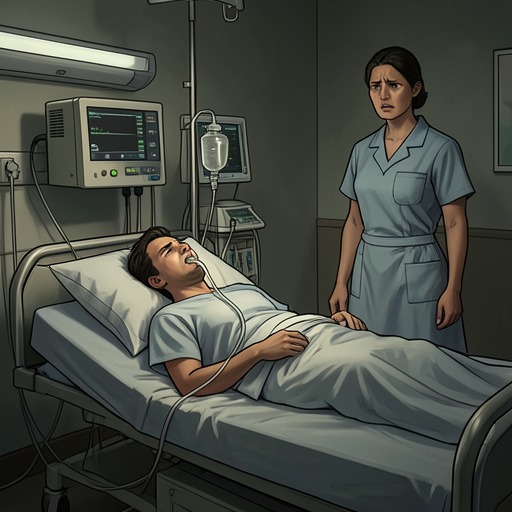
The room has two climate-control displays: one gives the temperature it should reach, the other the temperature it actually registers. Both show 21.2 degrees. The patient notes the precision and finds it reassuring, as if the matching figures confirm that the environment is functioning exactly as intended. The number first appears as ordinary clinical information, but its exactness gives it a disproportionate emotional weight: in a room full of unfamiliar apparatus, this is something he can read and briefly trust.
That trust is tested when he wakes again and finds both displays still at 21.2. A subversive thought interrupts his reassurance: perhaps the readings are inaccurate, perhaps the figures have simply frozen, perhaps the equipment is not working at all. The doubt is not resolved by new proof. Instead, he remembers that the actual-temperature display had briefly shown 21.1, a small cold snap that persuades him the system must be responsive. He checks again; it reads 21.2. The sequence turns a tenth of a degree into evidence, and checking the display becomes a small ritual through which he restores confidence.
Repetition and Vigilance
The temperature recurs as a refrain across the patient’s fragmented periods of sleep and wakefulness. After an examination, the room is still at 21.2; later, while a new nurse is on duty, the reading is again reported as unchanged. When the patient briefly thinks he sees 21.3, he corrects himself: no, 21.2. The quick rise and retreat of that mistaken reading exposes how closely he attends to the display. In a condition that denies him ordinary action, noticing and interpreting the number become actions in themselves.
The repetition also changes the number’s emotional character. At first, 21.2 offers reassurance because the two screens agree and the apparatus seems precise. Later, its constancy becomes almost oppressive: it has supposedly held steady for hours, “Since the time of the Romans, possibly.” The exaggeration makes duration feel both absurd and endless. The room may be stable, but the patient remains suspended inside it, listening, watching, and waiting for changes he cannot bring about.
The Number and the Patient’s Helplessness
Eventually, the patient decides to ignore the temperature and closes his eyes. His attention shifts from the climate display to a comparison between intensive care and cycling up Mont Ventoux against a headwind. Both can make a person feel like a living corpse, he reflects, but the pain of the climb is temporary. The contrast clarifies what the room’s fixed reading cannot measure: the patient’s deeper distress is not simply discomfort, but helplessness and uncertainty about whether others will judge his life useful enough to continue.
The 21.2-degree refrain therefore works through tension rather than symbolism alone. It is a concrete reading in a controlled room, but it also becomes a limited anchor for a mind trying to verify that something remains stable. The patient can question the displays, recall the brief 21.1 reading, mistake the number for 21.3, and correct himself; he cannot control the machinery around him or the decisions that may determine his future. Against that larger powerlessness, 21.2 persists: exact, repeatedly checked, and finally insufficient to reassure him.